
 Texas Air Duct Pros
Air duct & dryer vent cleaning
Air Duct and Dryer Vent Cleaning, Planned for Texas Homes
We look at your system first, explain what we can reach and what cleaning will and won't do, and put the scope in a written estimate before any work starts. Enter your ZIP code in the estimate form to check whether we can schedule service at your address.
$99 Basic Air Duct Cleaning + FREE Inspection | $79 Basic Dryer Vent Cleaning
- Inspection before cleaning
- Floors & furnishings protected
- Air ducts & dryer vents
- Scope confirmed in your estimate
 Illustrative image
Choose Your Cleaning Service
Two basic cleaning options. Choose the service you need and request an appointment.
Basic Air Duct Cleaning
$99Basic cleaning with an inspection included at no extra charge.
FREE Inspection Included
We confirm exactly what's covered for your home when we contact you, before any appointment is scheduled.
Available in confirmed service areas. We confirm availability for your address before scheduling.
Get the $99 OfferSee What's Included
Basic Dryer Vent Cleaning
$79Basic dryer vent cleaning.
We confirm exactly what's covered for your home when we contact you, before any appointment is scheduled.
Available in confirmed service areas. We confirm availability for your address before scheduling.
Get the $79 OfferSee What's Included
The free inspection is included with Basic Air Duct Cleaning only.
Texas services
Air Duct & Dryer Vent Cleaning in Texas
Two focused services with a clear scope — here's what each involves for homes in the state.
Air Duct Cleaning
NOAA describes Texas summers as hot and its winters as mild to cool, and Florida Solar Energy Center research describes attic air handlers as a…
Learn more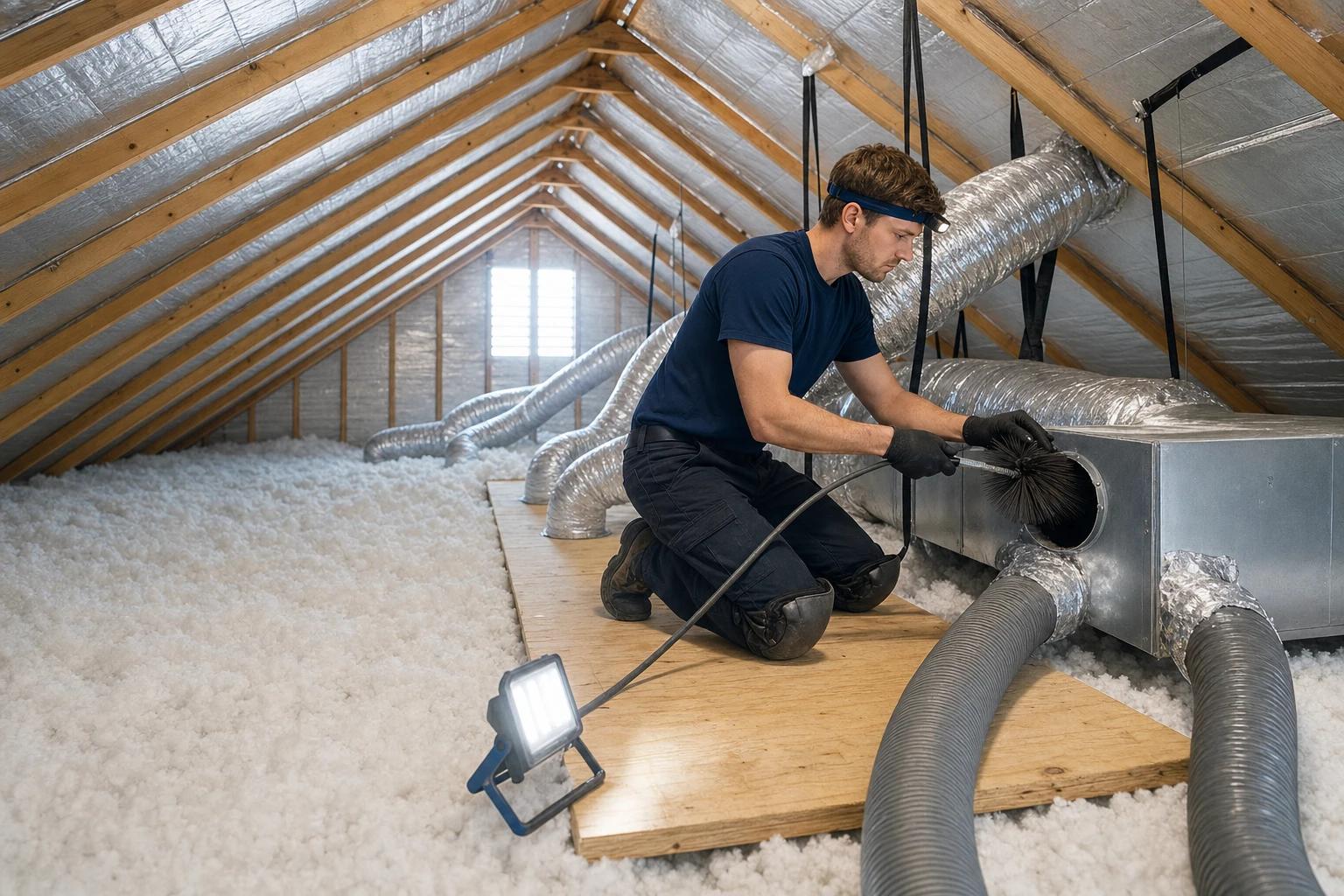
Dryer Vent Cleaning
The Texas Department of Insurance gives specific advice on dryer vents: make sure the vent pipe leads outside and isn't blocked, and clean the lint…
Learn more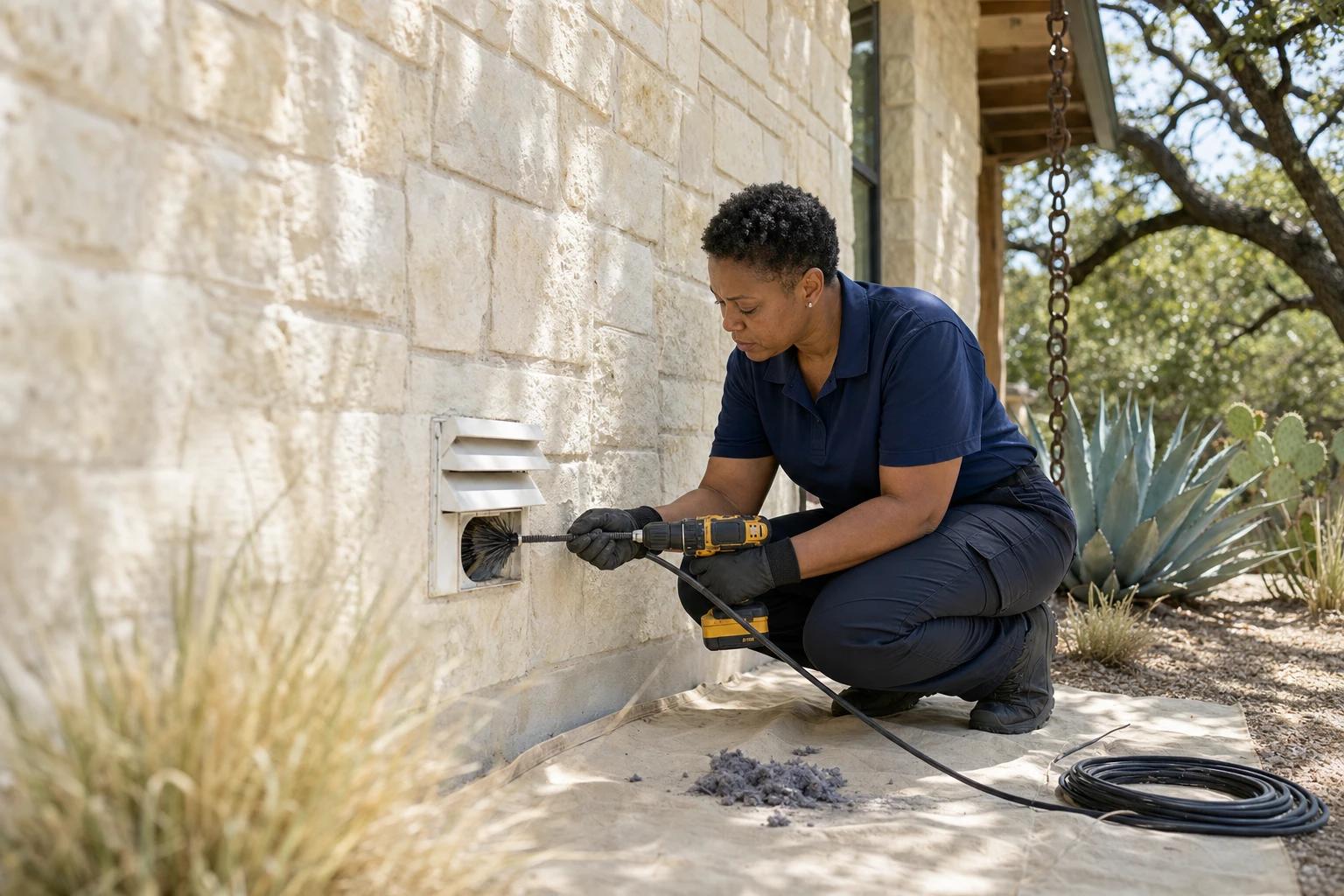
Local to Texas
What Texas Homes Have in Common
One state, several climates
NOAA describes Texas as having hot summers and mild to cool winters, but conditions vary widely across the state: normal yearly precipitation ranges from less than 10 inches in the far west to more than 60 inches in the extreme southeast, and typical January lows run from about 20°F in the northern Panhandle to about 50°F near the mouth of the Rio Grande.
The Department of Energy's Building America program places Texas counties in four different climate regions — hot-humid, hot-dry, mixed-dry, and mixed-humid — and the 2021 International Energy Conservation Code (IECC) assigns Texas counties to zones from 1A to 4B. In practice that means a duct system in Houston faces a different mix of moisture and dust than one in El Paso or Amarillo.
| County (largest city) | Building America region | IECC 2021 zone |
|---|---|---|
| Harris (Houston) | Hot-humid | 2A |
| Bexar (San Antonio) | Hot-humid | 2A |
| Travis (Austin) | Hot-humid | 2A |
| Dallas and Tarrant (Dallas, Fort Worth) | Hot-humid | 2A (reclassified from 3A in 2021) |
| El Paso (El Paso) | Hot-dry | 3B |
| Lubbock (Lubbock) | Hot-dry | 3B |
| Potter and Randall (Amarillo) | Mixed-dry | 4B |
Sources: NOAA NCEI — State Climate Summaries 2022: Texas; PNNL for U.S. DOE Building America — Guide to Determining Climate Zones by County (PNNL-33270, 2022)
Blowing dust on the South Plains and in the Panhandle
West Texas can see intense wind-driven dust. The National Weather Service office in Lubbock documented a March 14, 2025 event in which the storm hit the South Plains, Rolling Plains, and southern Texas Panhandle; thick blowing dust dropped visibility to a half mile or less, and many locations, particularly downwind of open fields and construction sites, experienced brownout conditions. Lubbock's airport recorded an 82 mph gust, the highest spring gust on its record dating back to 1945.
A dust event doesn't automatically mean your ducts need cleaning. EPA's guidance is to use the highest-efficiency filter your system's manufacturer recommends and change filters regularly; it suggests considering duct cleaning when ducts are clogged with excessive dust and debris or particles are actually coming out of the supply registers.
Sources: National Weather Service Lubbock — Historic wind, thick blowing dust and critical fire weather (March 14, 2025); U.S. EPA — Should You Have the Air Ducts in Your Home Cleaned?
Few basements, so the equipment is often overhead
In the Energy Information Administration's 2020 Residential Energy Consumption Survey, only about 2 percent of occupied Texas homes had a basement, compared with 30 percent nationally, and 83 percent used central air conditioning. With no basement to hold the equipment, the air handler and ducts have to go somewhere else — and Florida Solar Energy Center research describes putting the air handler in the attic as a common practice in much of the southern U.S.
When the equipment and ducts are overhead, a cleaning visit depends on a safe way into the attic — a hatch or pull-down stairs — and on reaching the runs without damaging insulation or ceilings. Attics also get hot: in the same FSEC research, attic air in a Florida test home (in Cocoa) reached up to 136°F in summer even with a radiant barrier. Texas attics weren't measured in that study, but the point about working conditions carries over, so it helps to mention where your equipment is when you request an estimate.
Sources: U.S. EIA — 2020 RECS: Highlights for structural characteristics of U.S. homes by state; U.S. EIA — 2020 RECS: Highlights for air conditioning in U.S. homes by state; Florida Solar Energy Center (UCF) — Performance Assessment of Photovoltaic Attic Ventilator Fans (FSEC-GP-171-00)
Storm season along the Gulf Coast
NOAA counts more than 85 tropical storms and hurricanes affecting Texas from 1900 to 2020 — about three storms every four years. If flood water reaches your heating and cooling equipment, EPA advises not using the system to help dry out the house.
EPA also notes that insulated air ducts whose insulation gets wet or moldy cannot be effectively cleaned and should be removed and replaced. Flood restoration and mold remediation are separate trades; we don't provide them, and we'll say so if that's what a system needs.
Sources: NOAA NCEI — State Climate Summaries 2022: Texas; U.S. EPA — Flood Cleanup to Protect Indoor Air and Your Health; U.S. EPA — Should You Have the Air Ducts in Your Home Cleaned?


Cleaner ducts. Clearer dryer vents.
Every visit starts with a look at your system, so the work matches what your home actually needs.
- Supply & return ducts
- Registers & grilles
- Dryer vent lines
- Exterior vent hoods
How it works
What a Cleaning Visit Looks Like
A straightforward sequence, adjusted to your home and the service you choose.
- 1
Inspect
We look at the accessible ductwork or dryer vent run, note access points, and confirm the scope with you.
- 2
Protect & prepare
Floors and furnishings near the work area are covered, and registers or vent openings are prepared.
- 3
Clean
Accumulated dust, debris, or lint is loosened and removed from the components in scope using professional equipment.
- 4
Verify & review
We check the result, reassemble what was opened, and walk you through what we found and anything outside our scope.
Cities
Where We Work in Texas
City pages list local details for areas where coverage is confirmed.
Houston
Texas
San Antonio
Texas
Dallas
Texas
Fort Worth
Texas
Austin
Texas
El Paso
El Paso County, Texas
Arlington
Tarrant County, Texas
Corpus Christi
Texas
FAQ
Texas Questions
- Texas guide
After a West Texas Dust Storm: Filters, Registers, and Dryer Vents
After a heavy dust event, start with the HVAC filter and the outdoor dryer vent hood, not the ducts. EPA recommends duct cleaning only as needed — for example, when ducts are clogged with excessive dust and debris or dust is visibly coming out of the supply registers. An inspection tells you whether your system has reached that point.
Read the guide
Is Texas Air Duct Pros a separate local company?
No. Texas Air Duct Pros is the name USA Air Duct Pros uses for its Texas pages. It isn't a separate company, franchise, or local office, and customers request service directly from USA Air Duct Pros.
How do I find out whether you can come to my address?
Enter your ZIP code in the estimate form. We confirm availability for your address before anything is scheduled, and we don't assume coverage for any city or county until we've confirmed it.
What affects the estimate for a Texas home?
Mostly the home itself: how many supply and return runs there are, whether the equipment is in the attic, a closet, or the garage, how easy the attic is to reach, whether there's more than one system, and — for dryer vents — how long the vent is and whether it ends on a wall or the roof. We confirm the scope in writing before work starts.
Does the time of year matter for attic work?
There's no required season — EPA recommends duct cleaning as needed, not on a calendar. Summer attic heat can be intense, though (Florida Solar Energy Center researchers measured attic air up to 136°F in a Florida test home), so it's reasonable to ask about timing when you book attic work.
Source: U.S. EPA — Should You Have the Air Ducts in Your Home Cleaned?; Florida Solar Energy Center (UCF) — Performance Assessment of Photovoltaic Attic Ventilator Fans (FSEC-GP-171-00)
Request an appointment
Tell Us About Your Home
Two quick steps. We'll follow up to confirm availability and details for your address.
- 1We review your requestYour details go to the team for your area and to SEO Office OS, our own website-measurement app.
- 2We contact youWe confirm availability, what's covered for your home, and any questions about access.
- 3You decideNothing is scheduled until you've confirmed the details with us.