
Missouri Air Duct Pros · Dryer Vents
Dryer Vent Cleaning in Missouri
Lint and debris cleared from the vent path, from the dryer connection to the outside hood, with the scope set in a written estimate.
Basic Dryer Vent Cleaning
Basic dryer vent cleaning.
Available in confirmed service areas. We confirm availability for your address before scheduling.
Get the $79 Offer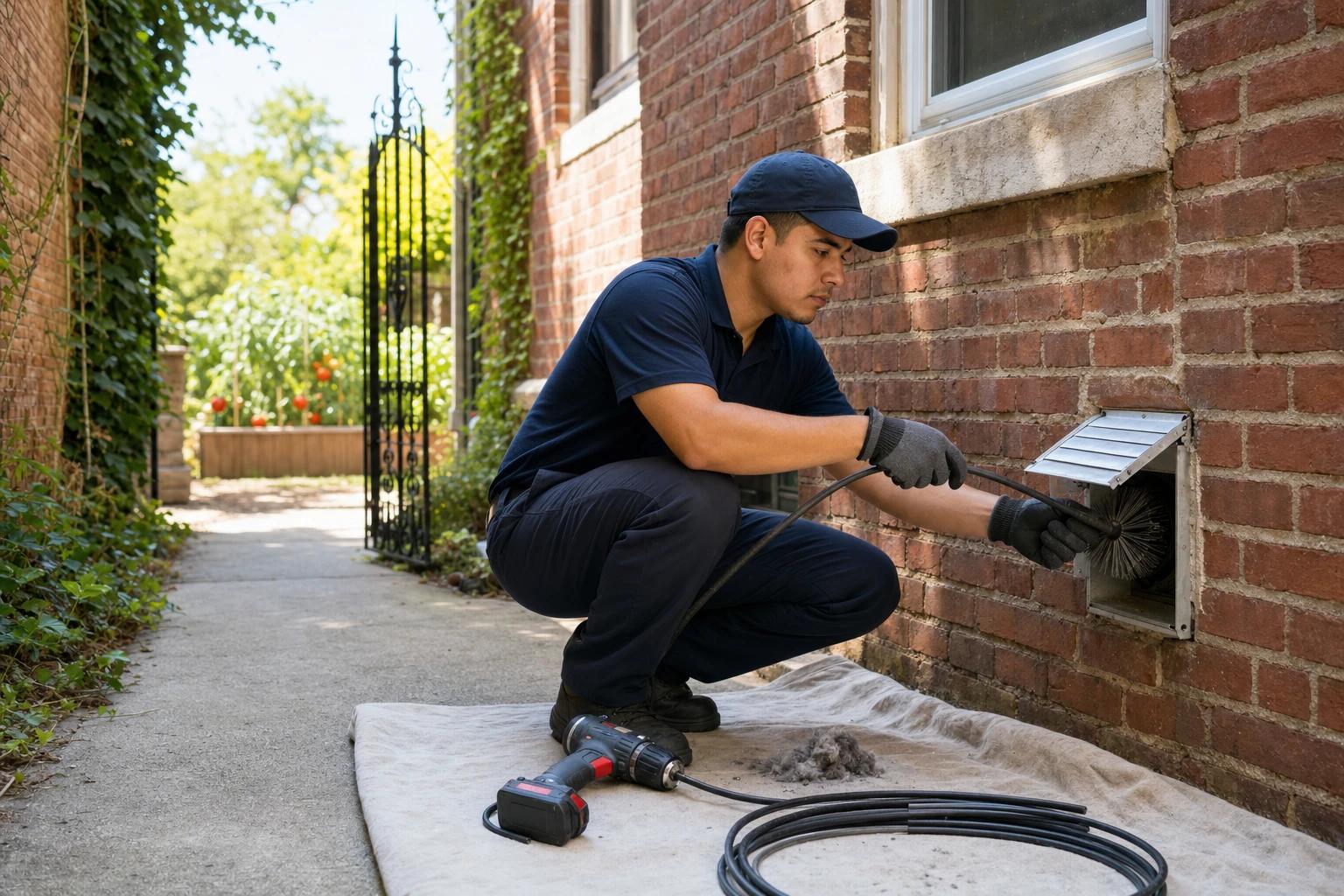 Illustrative image
Dryer Vents in Missouri
Missouri Air Duct Pros cleans the dryer's exhaust path — the transition duct, the vent run and the exterior hood — and confirms the flap opens while the dryer runs. University of Missouri Extension recommends exhausting dryers outdoors to carry moist air out of the house, which matters in a humid summer.
Where the laundry is in a basement, the vent may have to climb and turn to reach an outside wall. USFA notes that long vents and vents with many bends attract lint because moisture in the exhaust condenses on the vent walls.
Scope
What's Cleaned — and What Isn't
Dryer vent cleaning removes lint and debris from the exhaust path that carries hot, moist air from your clothes dryer to the outdoors: the transition duct behind the dryer, the vent duct inside the wall, floor, or ceiling, and the exterior vent hood. The U.S. Fire Administration describes lint as highly combustible and notes that accumulated lint reduces airflow; it reports that failure to clean was the leading factor contributing to ignition in home clothes dryer fires from 2018 to 2020. Cleaning reduces lint buildup in the parts that are cleaned, but it can't guarantee a fire will never happen, and it is not appliance, gas, or electrical repair.

Typically included
- The transition duct that connects the back of the dryer to the wall or floor vent
- The vent duct run inside walls, floors, ceilings, or crawlspaces, reached from its ends or accessible sections
- The exterior vent hood or wall cap, including lint and debris around the damper flap
- Old nesting material or debris blocking the outside vent opening, where it can be cleared safely (live animal removal is not included)
- Roof vent terminations, only when they can be reached safely and are listed in your estimate
- Final scope is confirmed in your written estimate: the vent route, which sections are included, and how each end is reached
Not included
- Dryer repair, parts replacement, or cleaning inside the dryer cabinet — CPSC recommends a qualified service person for the dryer's interior
- Gas line or gas connection work of any kind
- Electrical work, including outlets, plugs, cords, and wiring
- Installing, rerouting, or replacing vent duct, transition duct, or vent hoods — quoted separately only if offered and listed in your written estimate
- Opening walls, ceilings, or finished surfaces to reach concealed ducts, and any carpentry, drywall, or roofing repair
- Live animal removal or pest control
- HVAC air duct cleaning, which is a separate service with its own estimate
Process
How Dryer Vent Cleaning Works
- 1
Inspect
We trace the vent from the dryer to the outside termination, check the transition duct's material and condition, see whether exhaust air escapes and the outdoor flap opens with the dryer running, and confirm the scope in a written estimate.
- 2
Protect and prepare
The dryer is turned off and carefully moved away from the wall without straining gas, electrical, or water connections, the work area is protected, and the transition duct is disconnected from the dryer so the vent run can be cleaned. Gas lines are never disconnected.
- 3
Clean
Lint and debris are cleared from the vent run with brushes and vacuum collection, working from the dryer side, the exterior side, or both, and the exterior hood and flap are cleared.
- 4
Verify and review
The duct is reconnected to the dryer and the vent, the dryer is moved back, and we run it briefly to confirm exhaust air leaves through the outside vent and the flap opens. Then we review what was cleaned and anything that needs a qualified installer, appliance technician, or gas professional.
How the inspection works
We start by tracing the vent route from the back of the dryer to where it ends outside — usually an exterior wall or the roof — and checking how both ends can be reached. USFA notes that building codes require dryers to exhaust directly outdoors; if a vent ends in an attic, crawlspace, or other enclosed space, we'll point it out, and correcting it is a job for a qualified installer.
We look at the transition duct behind the dryer. CPSC notes that most manufacturers specify rigid or corrugated semi-rigid metal duct, and that plastic or foil accordion-type duct can more easily trap lint and is more likely to kink or crush.
We check whether exhaust air is escaping outside and whether the outdoor vent flap opens while the dryer runs — a check CPSC and NFPA also recommend homeowners make.
- Vent route, approximate length, and number of turns
- Transition duct material and any kinks, crushing, or disconnections
- Exterior hood condition, flap movement, and any screen that could trap lint
- Signs of nesting or other blockage at the outside opening
Sources: U.S. Fire Administration — Clothes Dryer Fires in Residential Buildings (2008–2010), Topical Fire Report Series Vol. 13, Issue 7; U.S. CPSC — Overheated Clothes Dryers Can Cause Fires (Publication 5022); NFPA — Clothes Dryer Safety tip sheet
Access: exterior walls, roofs, attics, crawlspaces, and multi-unit buildings
Most dryer vents are cleaned from both ends: from the laundry area with the dryer pulled away from the wall, and from the outside vent hood. There needs to be room to move the dryer without straining its gas line, power cord, or any water connection.
Exterior wall terminations need a clear path to the outside vent hood. Ground-level hoods are usually straightforward; higher hoods need safe ladder placement.
Roof terminations are evaluated case by case. Roof pitch, height, material, and weather affect whether a roof vent can be reached safely. If it can't, we'll explain what was cleaned from inside and what wasn't.
Vent ducts that pass through attics or crawlspaces may need a safe access point so connections along the run can be checked.
In condos, apartments, and other multi-unit buildings, vents may run long distances, connect to building-owned exhaust systems, or end on a roof or upper-story wall the building controls. Check with your HOA or property manager first — shared or building-owned vents may need their approval or their own contractor.
Basement laundry rooms and moisture
About 53% of Missouri homes have a basement (RECS 2020), and where the laundry is down there, the dryer's exhaust starts below grade. MU Extension links damp basements to humid air condensing on cool surfaces and recommends venting dryers outside to remove moist air; its weatherizing guide also lists dryer vent wall connections among the places to check for air leaks.
A basement vent that has to climb and turn is worth watching: USFA explains that when a vent is long or has many bends, moisture in the warm exhaust condenses on the vent walls and attracts lint. During a cleaning visit we check that the transition duct is connected at both ends and that exhaust leaves through the outside hood. Sealing or rebuilding a leaking wall connection isn't part of cleaning; it's quoted separately only if offered, or a qualified installer can handle it.
Sources: U.S. EIA — 2020 Residential Energy Consumption Survey, state highlights: structural characteristics; University of Missouri Extension — How to Prevent and Remove Mildew: Home Methods (GH5928); University of Missouri Extension — Insulating and Weatherizing Your Home (GH4881); U.S. Fire Administration — Clothes Dryer Fires in Residential Buildings (2008–2010), Topical Fire Report Series Vol. 13, Issue 7
North versus south: snow at the hood
NOAA notes that northern Missouri averages more than 20 inches of snow a year, compared with less than 5 inches in the south. NFPA's dryer tip sheet includes a winter check worth knowing in the north: make sure the outdoor vent flap is not covered by snow.
Sources: NOAA NCEI State Climate Summaries 2022 — Missouri; NFPA — Clothes Dryer Safety tip sheet
What cleaning can't do
Cleaning removes accumulated lint and debris from the parts of the vent system that are cleaned. It addresses a known risk factor, but it cannot guarantee that a dryer fire will never happen: in USFA's data, failure to clean was the leading factor contributing to ignition, not the only one.
Crushed, kinked, or plastic or foil transition ducts may need to be replaced by a qualified installer. CPSC recommends replacing plastic or foil accordion-type ducting with rigid or corrugated semi-rigid metal duct. Cleaning also doesn't correct a vent that is damaged, poorly routed, or ends indoors.
Gas lines, electrical connections, and the dryer itself are outside our scope. NFPA advises having gas dryers inspected by a qualified professional to make sure the gas line and connection are intact and free of leaks.
Vent cleaning doesn't replace everyday habits: NFPA and CPSC advise cleaning the lint filter before or after every load, and NFPA advises turning the dryer off if you leave home or go to bed.
- Damaged, disconnected, or improperly routed vents need a qualified installer
- Dryer repair or interior cabinet cleaning needs a qualified appliance service person
- Gas line or connection concerns need a qualified gas professional
- Outlet, plug, or wiring problems need a qualified electrician
Sources: U.S. Fire Administration — Clothes Dryer Fires in Residential Buildings (2008–2010), Topical Fire Report Series Vol. 13, Issue 7; U.S. CPSC — Overheated Clothes Dryers Can Cause Fires (Publication 5022); NFPA — Clothes Dryer Safety tip sheet
Signs you may want an inspection
USFA notes that if heavy items like jeans or towels take a long time to dry, or clothes feel hotter than usual at the end of the cycle, a clogged dryer vent is likely the problem. CPSC adds that clothes still damp after a typical cycle may mean the lint screen or exhaust duct is blocked.
If you smell burning, stop using the dryer, turn it off, and have it checked by a qualified professional before using it again. If there is smoke or fire, get everyone out and call 911.
- Drying takes longer than it used to, or clothes are still damp after a normal cycle
- Clothes feel hotter than usual at the end of a cycle, or the outside of the dryer gets noticeably hotter than it used to
- Lint collecting around the outside vent hood, or a vent flap that doesn't open when the dryer runs
- Nesting material or debris at the outside vent opening
- Plastic or foil accordion-style duct behind the dryer, or duct that is crushed or kinked
- It has been about a year since the vent was cleaned — NFPA suggests cleaning lint out of the vent pipe once a year, or more often if drying takes longer than normal
Sources: U.S. Fire Administration — Clothes Dryer Fires in Residential Buildings (2008–2010), Topical Fire Report Series Vol. 13, Issue 7; U.S. CPSC — Overheated Clothes Dryers Can Cause Fires (Publication 5022); NFPA — Clothes Dryer Safety tip sheet
FAQ
Dryer Vent Cleaning Questions
Why does my laundry room feel damp in summer?
Humid summer air is a common factor: MU Extension explains that dampness often comes from humid air condensing on cooler surfaces. A dryer that isn't exhausting fully outdoors adds to it, which is why MU Extension recommends venting dryers outside. We check the vent connections and the outside hood as part of cleaning.
Source: University of Missouri Extension — How to Prevent and Remove Mildew: Home Methods (GH5928)
Do I need to worry about snow on my dryer vent in Missouri?
It depends where you live. NOAA notes that northern Missouri averages more than 20 inches of snow a year while the south averages less than 5. After a real snowfall, check that the outdoor flap isn't covered — NFPA lists that as a basic dryer safety step.
Source: NOAA NCEI State Climate Summaries 2022 — Missouri; NFPA — Clothes Dryer Safety tip sheet
Air leaks in around my dryer vent's wall cap. Is fixing that part of cleaning?
No. MU Extension lists dryer vent wall connections among common air-leak spots, but sealing or replacing the wall cap is repair work. We'll point it out during the visit; it's quoted separately only if offered, or a qualified installer can do it.
Source: University of Missouri Extension — Insulating and Weatherizing Your Home (GH4881)
How often should a dryer vent be cleaned?
NFPA suggests cleaning lint out of the vent pipe once a year, or more often if clothes are taking longer than normal to dry. USFA notes that in vents that are too long or have many bends, moisture condenses on the vent surfaces and attracts lint. Either way, clean the lint screen before or after every load.
Source: NFPA — Clothes Dryer Safety tip sheet; U.S. Fire Administration — Clothes Dryer Fires in Residential Buildings (2008–2010), Topical Fire Report Series Vol. 13, Issue 7
Does dryer vent cleaning prevent dryer fires?
It addresses one of the biggest known risk factors, but no cleaning can guarantee against every fire. USFA reports that failure to clean was the leading factor contributing to ignition in clothes dryer fires: 34 percent in residential buildings in its 2008–2010 analysis, and 31 percent in homes from 2018 to 2020. Dryer fires have other causes too, so follow the manufacturer's instructions, clean the lint screen every load, and don't leave the dryer running when you leave home or go to bed.
Source: U.S. Fire Administration — Clothes Dryer Fires in Residential Buildings (2008–2010), Topical Fire Report Series Vol. 13, Issue 7; U.S. Fire Administration — Appliance and Electrical Fire Safety; NFPA — Clothes Dryer Safety tip sheet
Is the foil or plastic hose behind my dryer OK?
It's worth replacing. CPSC notes that most manufacturers specify rigid or corrugated semi-rigid metal duct, and that plastic or foil accordion-type duct can more easily trap lint and is more likely to kink or crush, which can greatly reduce airflow. USFA adds that manufacturers now state in their manuals not to use plastic flexible ducts. Duct replacement isn't part of our standard cleaning; it is quoted separately only if offered, or a qualified installer can do it.
Source: U.S. CPSC — Overheated Clothes Dryers Can Cause Fires (Publication 5022); U.S. Fire Administration — Clothes Dryer Fires in Residential Buildings (2008–2010), Topical Fire Report Series Vol. 13, Issue 7
What about gas dryers?
The vent carries exhaust outdoors whether the dryer is gas or electric, but we don't disconnect, repair, or test gas lines or connections. NFPA and USFA advise having gas dryers inspected by a qualified professional to make sure the gas line and connection are intact and free of leaks.
Source: NFPA — Clothes Dryer Safety tip sheet; U.S. Fire Administration — Clothes Dryer Fires in Residential Buildings (2008–2010), Topical Fire Report Series Vol. 13, Issue 7
Can I clean the dryer vent myself?
Some of it, yes. CPSC advises cleaning the lint screen every load, cleaning behind the dryer where lint builds up, cleaning the vent and exhaust duct periodically, and checking that exhaust air escapes outside while the dryer runs. If you disconnect the duct, reconnect it to the dryer and the outside vent before using the dryer again. Long, concealed, or roof-terminated vents can be harder to clean thoroughly.
Source: U.S. CPSC — Overheated Clothes Dryers Can Cause Fires (Publication 5022)
Where should my dryer vent end?
Outdoors. USFA notes that building codes require dryers to exhaust directly to the outdoors and prohibit venting into attics, soffits, ridge vents, or crawl spaces. If your vent ends indoors or in an enclosed space, a qualified installer should correct it — cleaning alone won't fix it.
Is dryer vent cleaning the same as air duct cleaning?
No. A dryer vent carries hot, lint-laden air from your clothes dryer to the outdoors; air ducts move heated and cooled air through your home. They are separate systems with separate concerns, and we clean them as separate services.
Cities
Dryer Vents by City in Missouri
Kansas City
Missouri
St. Louis
Missouri
Springfield
Missouri
Columbia
Boone County, Missouri
Independence
Missouri
Lee's Summit
Missouri
Request an appointment
Tell Us About Your Home
Two quick steps. We'll follow up to confirm availability and details for your address.
- 1We review your requestYour details go to the team for your area and to SEO Office OS, our own website-measurement app.
- 2We contact youWe confirm availability, what's covered for your home, and any questions about access.
- 3You decideNothing is scheduled until you've confirmed the details with us.