
 Florida Air Duct Pros
Air duct & dryer vent cleaning
Florida Air Duct & Dryer Vent Cleaning, With Humidity in Mind
We inspect first, explain what cleaning can and can't do in a humid climate, and confirm the scope in a written estimate. Enter your ZIP code in the estimate form to see whether we can schedule a visit at your address.
$99 Basic Air Duct Cleaning + FREE Inspection | $79 Basic Dryer Vent Cleaning
- Inspection before cleaning
- Floors & furnishings protected
- Air ducts & dryer vents
- Scope confirmed in your estimate
 Illustrative image
Choose Your Cleaning Service
Two basic cleaning options. Choose the service you need and request an appointment.
Basic Air Duct Cleaning
$99Basic cleaning with an inspection included at no extra charge.
FREE Inspection Included
We confirm exactly what's covered for your home when we contact you, before any appointment is scheduled.
Available in confirmed service areas. We confirm availability for your address before scheduling.
Get the $99 OfferSee What's Included
Basic Dryer Vent Cleaning
$79Basic dryer vent cleaning.
We confirm exactly what's covered for your home when we contact you, before any appointment is scheduled.
Available in confirmed service areas. We confirm availability for your address before scheduling.
Get the $79 OfferSee What's Included
The free inspection is included with Basic Air Duct Cleaning only.
Florida services
Air Duct & Dryer Vent Cleaning in Florida
Two focused services with a clear scope — here's what each involves for homes in the state.
Air Duct Cleaning
In a humid climate, signs that get blamed on dirty ducts, such as dark spots around vents or a musty smell, can point to a moisture problem instead…
Learn more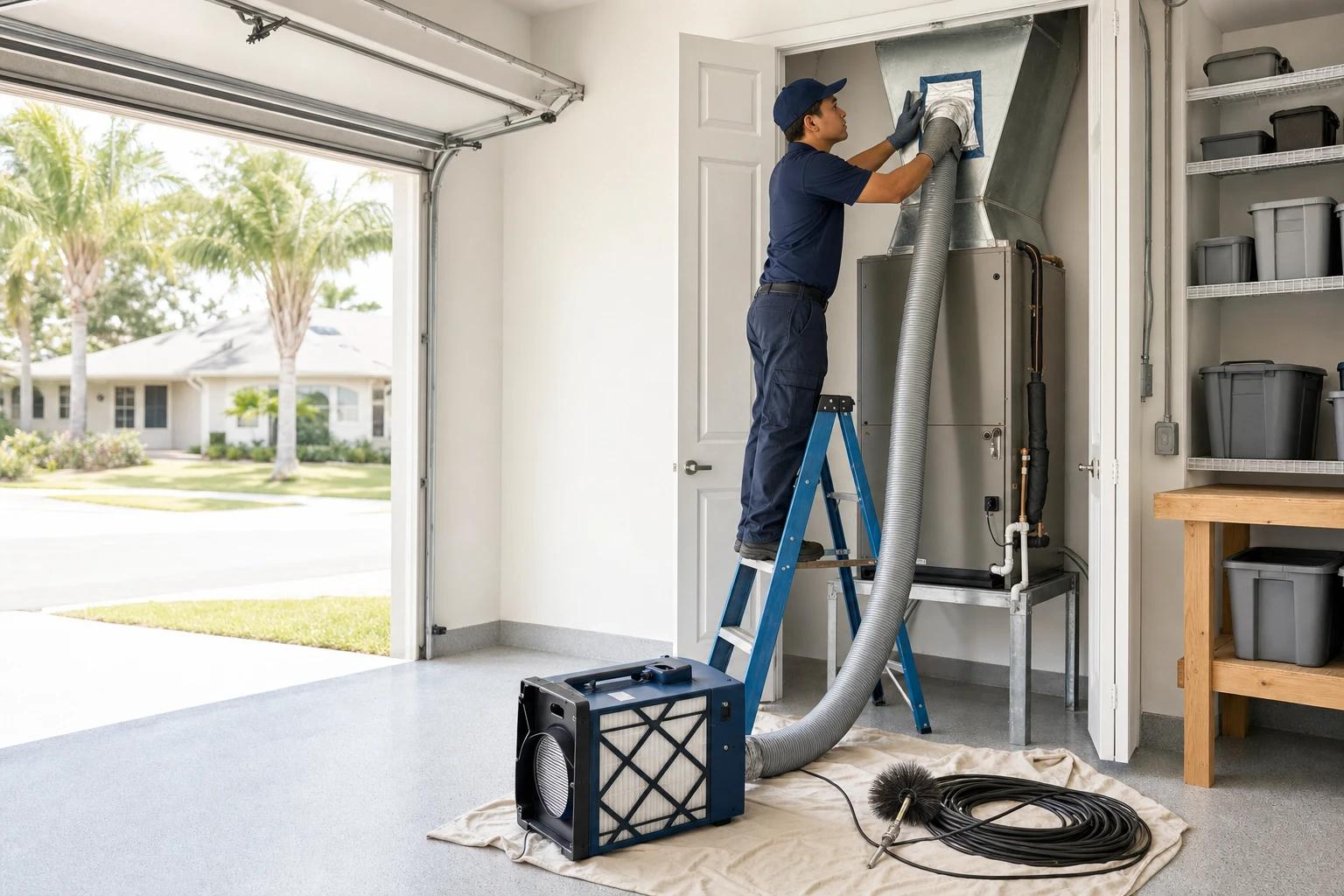
Dryer Vent Cleaning
In Florida condominiums, townhomes, and apartment buildings, a dryer vent can run through interior walls or up to the roof before it reaches the…
Learn more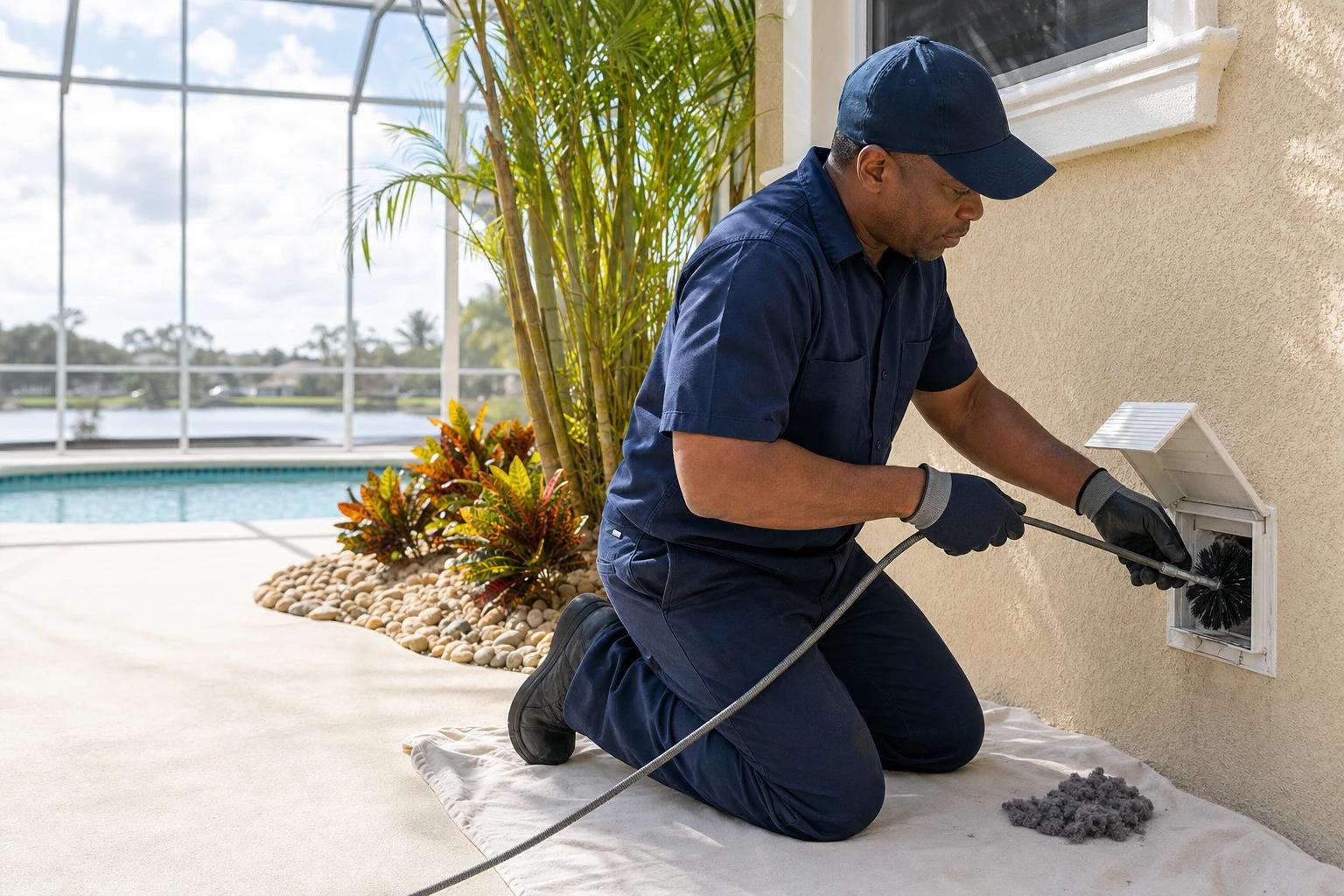
Local to Florida
What Florida Homes Have in Common
The most humid state in the nation
NOAA calls Florida the most humid state in the nation, with hot, humid summers and mild winters. Average January temperatures range from the lower 50s°F in the north to the upper 60s°F in the south, and more of the state's rain falls in the warmer months of June through September.
Every one of Florida's 67 counties falls in the Department of Energy's Building America hot-humid climate region. Under the 2021 IECC, Miami-Dade, Broward, Monroe, and Palm Beach counties are in climate zone 1A (Palm Beach was moved there from 2A in the 2021 edition), and the rest of the state is zone 2A.
Sources: NOAA NCEI — State Climate Summaries 2022: Florida; PNNL for U.S. DOE Building America — Guide to Determining Climate Zones by County (PNNL-33270, 2022)
Humidity, condensation, and your system
In a humid climate, moisture matters more to a duct system than dust does. EPA identifies condensation on or near air conditioner cooling coils as a major factor in moisture contamination of the system, and says controlling moisture is the most effective way to prevent biological growth in air ducts.
UF/IFAS Extension recommends keeping indoor relative humidity below 70 percent — ideally between 45 and 60 percent — and notes that humidity above 70 percent for long periods can eventually lead to mold problems. It also points out that during very humid weather, especially rainstorms, the air conditioner often doesn't run long enough to control indoor humidity.
Sources: U.S. EPA — Should You Have the Air Ducts in Your Home Cleaned?; UF/IFAS Extension — Energy Efficient Homes: Indoor Air Quality and Energy (FCS3275)
Where the equipment sits
Central air is the norm here: in the Energy Information Administration's 2020 Residential Energy Consumption Survey, about 90 percent of occupied Florida homes used central air conditioning (67 percent nationally), and main heating was split between furnaces (33 percent) and central heat pumps (31 percent).
Florida Solar Energy Center research describes attic air handlers as a common practice in much of the southern U.S., and measured attic air temperatures above 130°F in a Florida test home in summer. Air handlers can also sit in a garage or an indoor closet, which changes how a technician reaches the system.
UF/IFAS Extension notes that ducts in unconditioned attics or garages waste energy if they're poorly insulated, that typical duct systems lose 25 to 40 percent of the heating or cooling energy they carry, and that an improperly sealed air handler in a garage can pull in poor-quality outdoor air or vapors from the garage. Cleaning doesn't seal or insulate ducts — that's HVAC contractor work.
Sources: U.S. EIA — 2020 RECS: Highlights for air conditioning in U.S. homes by state; U.S. EIA — 2020 RECS: Highlights for space heating in U.S. homes by state; Florida Solar Energy Center (UCF) — Performance Assessment of Photovoltaic Attic Ventilator Fans (FSEC-GP-171-00); UF/IFAS Extension — Energy Efficient Homes: The Duct System (FCS3263)
Hurricanes and flooding
NOAA reports that hurricane-force winds affect Florida an average of three times every five years. If flood water reaches your heating and cooling system, EPA advises not using it to help dry out the house.
EPA also says insulated ducts whose insulation gets wet or moldy can't be effectively cleaned and should be removed and replaced. Flood restoration and mold remediation are separate services we don't provide.
Sources: NOAA NCEI — State Climate Summaries 2022: Florida; U.S. EPA — Flood Cleanup to Protect Indoor Air and Your Health; U.S. EPA — Should You Have the Air Ducts in Your Home Cleaned?


Cleaner ducts. Clearer dryer vents.
Every visit starts with a look at your system, so the work matches what your home actually needs.
- Supply & return ducts
- Registers & grilles
- Dryer vent lines
- Exterior vent hoods
How it works
What a Cleaning Visit Looks Like
A straightforward sequence, adjusted to your home and the service you choose.
- 1
Inspect
We look at the accessible ductwork or dryer vent run, note access points, and confirm the scope with you.
- 2
Protect & prepare
Floors and furnishings near the work area are covered, and registers or vent openings are prepared.
- 3
Clean
Accumulated dust, debris, or lint is loosened and removed from the components in scope using professional equipment.
- 4
Verify & review
We check the result, reassemble what was opened, and walk you through what we found and anything outside our scope.
Cities
Where We Work in Florida
City pages list local details for areas where coverage is confirmed.
Jacksonville
Duval County, Florida
Miami
Miami-Dade County, Florida
Tampa
Hillsborough County, Florida
Orlando
Orange County, Florida
St. Petersburg
Pinellas County, Florida
Port St. Lucie
St. Lucie County, Florida
Hialeah
Miami-Dade County, Florida
Cape Coral
Lee County, Florida
FAQ
Florida Questions
- Florida guide
Florida Humidity and Your Air Ducts: What Cleaning Can and Can't Fix
In Florida, moisture is usually the first thing to address in a heating and cooling system. Duct cleaning removes accumulated dust and debris from the components that are cleaned, but it doesn't lower indoor humidity, fix a clogged condensate drain, or seal leaky ducts — and EPA warns that mold growth returns if the underlying moisture problem isn't corrected.
Read the guide
Is Florida Air Duct Pros a separate company with a Florida office?
No. Florida Air Duct Pros is the name USA Air Duct Pros uses for its Florida pages. It isn't a separate company or a local branch office, and you request service directly from USA Air Duct Pros.
How can I tell whether you serve my part of Florida?
Enter your ZIP code in the estimate form. We confirm availability for your specific address before scheduling anything, and we don't assume we cover a city or county until that's confirmed.
What affects the estimate for a Florida home?
Where the air handler is (attic, garage, or closet), how many supply and return registers there are, how the attic is reached, and — in condos and apartments — building access rules such as association approval, parking, and elevator use. For dryer vents, the length of the run and whether it ends on a wall or the roof matter most.
Do you test for mold or treat ducts with chemicals?
No. We don't diagnose or remediate mold, and we don't apply chemical treatments as a routine step. EPA notes that confirming mold may require an expert and laboratory analysis, and that no products are currently registered by EPA as biocides for use on fiberglass duct board or fiberglass-lined ducts.
Source: U.S. EPA — Should You Have the Air Ducts in Your Home Cleaned?
Request an appointment
Tell Us About Your Home
Two quick steps. We'll follow up to confirm availability and details for your address.
- 1We review your requestYour details go to the team for your area and to SEO Office OS, our own website-measurement app.
- 2We contact youWe confirm availability, what's covered for your home, and any questions about access.
- 3You decideNothing is scheduled until you've confirmed the details with us.